


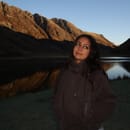
The past three summers, I’ve worked at a USDAN, a summer camp for the arts in Long Island. Nestled in the woods, the summer camp is a complete haven for creative self-expression.
I first attended as a camper when I was 16. It was an incredibly transformative time of my life, right after a soul-crushing breakup with my first love and before the stress of college applications. I spent two months in those woods making art and music, getting over my heartbreak, and grappling with growing pains in the face of my rapidly approaching final year of high school.
It’s not that I don’t want a prestigious summer job or internship in my field, but something just keeps drawing me back to camp. It was so rewarding to shift roles from camper to teacher and mentor, to be there for kids that were once in my shoes, and to engage in something that has remained a constant, grounding force in my life for as long as I can remember.
I bring up camp because it has a rule that leads to my point: “No Phones.” Simple, but powerful. Most of the camp doesn’t have service anyway, which helps.

It’s beautiful though, how present that lends you to be. For five hours, all the noise goes away. The world narrows to just you, the people around you, and your work.
That kind of silence is sacred today, when everything is digital and everyone seems perpetually glued to a screen. I don’t say that condescendingly, nor do I write this to be didactic. I encourage you all, though, to engage in exercises of silence.
This summer I spent my time divided between working at camp and studying for the LSAT — which, by the way, might be the hardest thing I’ve ever done. Call it a crash out or call it discipline, but that exam consumed me to a degree I didn’t know was possible. I ended up needing silence.
So I found ways to recalibrate. On my morning commute to camp — about an hour drive — I left the radio off. No music, no podcast, no NPR, nothing. Silence. Instead, I thought. I thought about my friends, my life, certain moments and experiences, where I’m going and where I’ve been. I thought about the LSAT. I questioned myself, I encouraged myself. I thought about my future.
Other times, I just sat and drove. I deleted TikTok, Instagram, and Snapchat. I went to work, the gym, and then I studied. I poured myself into everything I did and silence became my greatest asset.
On Saturdays, I would go to morning yoga classes. I love yoga because it forces you to be silent and present. You need to focus in order to sync your movement with your breathing. Not only does it feel incredible physically, but it helps mentally. As someone prone to overthinking, yoga was such a beneficial use of my time. Between all the poses and intense concentration on controlling your breathing in tandem, there isn’t much room for rumination. I needed that.

On Sundays, I would go to live drawing sessions at a nearby art studio. Between the models being nude and the artists being over the age of 50, I remember being so surprised. Still, for months, I would go there to draw and challenge myself. I even brought a couple of now-exes there, including the aforementioned soul-crushing breakup.
I started going back this summer after a long hiatus. That was another exercise in silence. For three hours, I drew and thought. Sometimes I ruminated, but mostly, I just thought.
In all that drawing and thinking, I realized something: I don’t get frustrated when I draw. Everything is as I created it. Even when a drawing doesn’t turn out as I intended, I am in control. I have the privilege of trying again.
There’s a quote about that from Hanya Yanagihara’s A Little Life that remains resonant years after reading. It goes like this: “It was impossible not to think of your work as your colleague and co-participant, as if it was something that sometimes decided to be agreeable and collaborate with you, and sometimes decided to be truculent and unyielding, like a grouchy toddler — was just what happened. You had to just keep doing it, and doing it, and one day, you’d get it right.”
Aptly, that diagnoses my adoration for my Sunday drawing sessions. More broadly, I think it reflects my outlook on life. The world is truly what you make of it, but what can you make if you don’t give yourself the time or opportunity?
What’s so potent about all this silence and contemplation is the capacity for growth. This might be intellectually, personally, professionally, artistically, or any other infinite combination of possibilities. Humans aren’t designed to be sedentary and online all the time. We are meant to love and experience and create and move and, sometimes, be still.
I leave you with an excerpt from Robert Henri’s The Artful Painter — this was printed out and thumb-tacked to the wall inside my first USDAN studio. Reading it every day moved and inspired me. Whatever it is in your life that occupies the place art does in mine, I hope you take something meaningful from his words.

“Be a warhorse for work, and enjoy even the struggle against defeat. Keep painting, it’s the best thing in the world to do. Learn that there are different views and that it is up to you to make your own judgments.
“See the value in compositional work and don’t be a life-class hack. Don’t believe that sitting in an art school and patiently patting paint on canvases will eventually make you an artist. There is more than that. If a new movement in art comes along, be awake to it, study it, but don’t belong to it. Have a personal humor about things.
“You will never know your calibre until you have tried yourself. Avoid idle industry. Always leave out the padding. Be venturesome. Try new things that appeal to you. Examine others. Have a pioneer spirit. Prevent your drawing from being common. Put life into it.
“The way to do this is to see the model, see that the model is great, wonderful — a human creature there before you in the tragedy and comedy of life — then draw. Avoid mannerisms, your own and other people’s. Preserve your originality by painting what is before you as you see it, for things have a special look to you. Make your pictures of big pieces rather than small ones. Through the big pieces the statement can be made frankly and fully.
“Get the easy naturalness of nature. Nature is full of surprises. They happen equally in great and small events, and are inevitable results. They are parts of a sequence. Make your picture as full of surprises and as easy as nature. Don’t ever stock your head so full of “learning” that there will be no room left for personal thinking. Develop your power of seeing through the effort and pleasure of seeing.
“Develop the power to express through the effort and pleasure of expression.”
Put the phone down. Be okay with silence. I implore you to nourish your soul.
Want to keep up with HCBU? Make sure to like us on Facebook, follow us on Instagram, check out our Pinterest board, watch us on TikTok, and read our latest Tweets!