


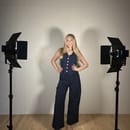
Josie Maw, 22, is exhausted by the very thing that promotes rest, relaxation, and self-focus: wellness. “From people posting their [running routes] on Insta, ‘gym transformations,’ or climbing videos, [wellness] is absolutely a performance,” the Salt Lake City resident tells Her Campus. “The public perception of fitness, health, and wellness has completely warped what it actually means to practice a health-conscious lifestyle.”
We’ve all seen it: the aesthetic posts about “clean girl” morning routines, constant matcha runs, and shelves stocked with gym supplements — or influencers wearing under-eye patches to not only hot Pilates class, but to brunch with the girls. But despite garnering massive engagement online, many viewers like Maw are noticing something: On social media, and even IRL, wellness is becoming less of a practice and more of a performance. And in this era of “performative wellness,” where creators navigate what to share, audiences navigate something just as complicated: how much of it to believe.
Lily Brown, 23, considers herself a “bit of a sucker for wellness trends.” However, the constant fitness and wellness trends have made it hard to distinguish what actually works and what’s just for the aesthetic. “I’m usually down to try things at least once,” the Emerson College graduate student tells Her Campus. “But I’ve also had to get better at figuring out what’s actually useful for me, versus what’s performative or just trendy at the moment.”
When your feed is full of flawless routines, perfectly plated meals, and effortless-looking calm, your brain uses that as a benchmark — even when you consciously know it’s curated.
Dr. Daphna Laifenfeld
That feeling of confusion deepens when a trend is objectively good for your health, but also feels like it’s being used to show off. Leah*, 21, is a student at the University of Pittsburgh, and the public practice of wellness trends is becoming bothersome. “It bugs the crap out of me when I see people wear things like under-eye patches out and about,” she tells Her Campus, “I literally saw someone wearing them to a coffee shop last weekend — not just waiting in line to grab it on the go, but dressed up and sitting with friends.”
For Leah, wearing things like patches — which were once part of a private self-care ritual — out in public has turned a wellness practice into braggadocio. “It just feels so performative, like some kind of ‘wellness girlie’ status symbol,” she says. “They only need to stay on for 15 minutes! Why are they on for an hour, while you’re sweating, anyway?!”
Similarly, E.V. Byers, 20, feels strongly about the “morning shed” routine where creators put on loads of products — like sheet masks, jaw exercise bands, and peel-off lip stains — before bed. “There’s simply no way people actually do this every night,” the University of Missouri student tells Her Campus. ”That would be expensive and uncomfortable.” And these performative wellness trends aren’t just hard to believe, they’re unsustainable. “It also romanticizes consumerism,” Byers says, “especially of single-use products.”
This skepticism that wellness is being sold more than it’s being practiced extends beyond single-use products to unusual exercise equipment, food trends, and expensive rituals. “That vibrating plate people have that is supposed to help you lose fat, and the light-up face mask things — like what do those even do?” Alexa Bravo, a 23-year-old law student, says. “And why does everything have protein? We’ve lost the plot.”
The consumption of these questionable trends sometimes proves to be more maddening than motivating. Sociologist Dr. Jordan Ashley says that this misrepresentative, aesthetic influencer culture can cause “wellness anxiety” in the users who consume it. “Wellness shifts from being a tool for collective healing to a benchmark for individual failure,” says Ashley.
So why not tune it out entirely? Because, for all its flaws, not every piece of wellness content feels deceptive, and not every creator is. Influencer @wellnessbynaomi on TikTok has amassed over 40,000 followers by producing aesthetic wellness content. “I’ve always just been really passionate about healthy living,” Naomi says. She’s confident that her routine accurately reflects her life and isn’t simply a highlight reel, saying, “There’s nothing that I post about that I don’t actually do.”
Though Naomi expressed optimism that other creators are posting honest wellness content, she also admits that things like a 20-step morning routine aren’t realistic for everyone. “In the wellness space, there is a lot of emphasis on being perfect, never eating anything bad, and always going to the gym for an hour a day. It’s not realistic,” Naomi says. “It’s about being 1% better every day instead of trying to chase perfection.”
Still, even when creators push for balance, the impact can be hard to control. Neuroscientist Dr. Daphna Laifenfeld says that even though most of us are aware that social media is unrealistic and full of performances, it can still make us feel less than. “Social comparison theory tells us that humans naturally evaluate themselves against others, particularly in areas where there’s no objective standard,” Laifenfeld says. “Wellness is one of the murkiest of those areas: When your feed is full of flawless routines, perfectly plated meals, and effortless-looking calm, your brain uses that as a benchmark — even when you consciously know it’s curated.”
When social media is saturated with both influencers and everyday people posting performative wellness content, that perceived gap can feel unavoidable — even for those who already feel good about their habits.
Ginger Koehler
Laifenfeld adds that humans experience what researchers call upward social comparison, where we are always comparing ourselves to people who we believe are doing better than we are. “In small doses, that can be motivating,” she says, “but sustained exposure tends to erode self-worth, particularly when the gap between what you see and what you’re living feels large.”
And when social media is saturated with both influencers and everyday people posting performative wellness content, that perceived gap can feel unavoidable — even for those who already feel good about their habits. However, that doesn’t mean that folks can’t find a balance. While all-or-nothing trends like 75 Hard or extreme “maxxing” trends aren’t her bread and butter, Brown says that, at the end of the day, watching the practice of wellness inspires her. “I’ve definitely incorporated some aspects of [popular wellness trends] into my life,” she says. “Mainly, the emphasis on consistency, building structure into my day, and being more intentional about habits rather than just floating through them.”
And though Leah, like many others, is skeptical of wellness trends, she still believes they have a time and place. “I could see myself wearing under-eye patches in the car when I’m in a rush — definitely not outside, though,” she says. “Things like wellness should be done for yourself, not as a part of a trend.”
*Names have been changed for privacy purposes.