


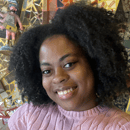
On June 15, 2020, I did something my younger self would call unthinkable and cut my hair. It wasn’t a trim, a bob, or pixie — I did the big chop. It was a decision I was considering for months.
In February 2020, during my senior year of high school, I decided I wanted to see what my natural hair looked like. At that point, I knew what it looked like from photos when I was a toddler, but I had merely seen glimpses of it growing up before my hair was blown dried, straightened, or braided. As a teenager, my hair had been damaged by texturizers, relaxers, and then doing an ombre with an at-home kit. My hair wasn’t healthy (and I knew that), but I wanted to maintain a decent length.
Hair length was a priority for me even during my childhood. As a kid, my hair was considered long and I was keen on not cutting it unless for trims. By straightening it, I could show off the length. By texturing it, I could have “nice curls.” It was ingrained in my mind that straight, long hair (or anything close to it) was “good hair.”
So what exactly, then, sparked my desire to see my curls? For me, it was a combination of things. For one, seeing photos of my afro as a kid made me wonder what my natural hair would look like at the time if I hadn’t manipulated it. Plus, considering the damage I had done to my hair, I wanted to press reset and prioritize healthy hair in its natural state. So, I started growing out my natural hair in February.
On that day in June, I cut off my relaxed hair, only leaving the new growth. I wanted to give myself time to figure out my hair before I started college.

Once I cut my hair, there was no turning back, and I remember feeling insecure. This was the shortest my hair had ever been. Do I look awkward? Am I just one of those people who can’t pull off short hair? Do I look feminine enough? That last question wasn’t simply the insecurity talking. It was a question that loomed in my head with any major decision I made about my hair since youth: style, length, and how it fit with my overall appearance. For me, this was a loaded question (just as the phrase “good hair” was) that tied my hair to my race and gender.
After I cut my hair, I had to get used to seeing myself with a teeny-weeny afro, and figure out what products worked for me. For months, I had watched videos to learn about caring for my natural hair — I probably knew every curly girl influencer on social media at that time.
More than anything, I was ready to give my hair love and see it grow. Post big chop, I documented everything. All the products I used, my hair length, and photos of the progress. Since I did the big chop during the pandemic and everything was remote, I could experiment with hairstyles. I started doing different styles that were new to me, like wash-n-gos, twist outs, box braids, and knotless braids.

Initially, my hair wasn’t holding curls for longer than overnight or a day, I had frizz, and refreshing my curls was trial and error. After a while, my hair started to get used to my wash-n-gos, and eventually the curls started lasting longer. During this time, I didn’t see doing my hair as a chore, but as therapy. I looked at ingredient labels, massaged my scalp, deep-conditioned almost weekly, and took all the steps I could to take care of my hair.
Almost six years after doing the big chop (I can’t believe I’m saying that), I can honestly say I don’t regret my decision. I am proud of my younger self for being bold. Since then, I’ve had good and bad hair days, but I’ve truly rid myself of “good hair” notions. Every curl on my head doesn’t need to be defined, and my natural hair is acceptable for the work environment. My big chop taught me so much about loving and caring for my curls, and at the end of the day, I’m really thankful for that.