


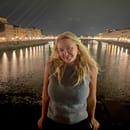
Rowan Ellis-Rissler
My search for how to live has always been rooted in art. Not because art is a hobby, or a luxury, or a break from reality, but because art feels like evidence to me. Evidence that something inside the human brain is still reaching, still rearranging itself, still trying to feel.
When I look at art, it feels like a faucet opens in my mind. Not information pouring in, but sensation — emotion being loosened, reorganized, tuned. Neuroscientists will tell you that when we encounter art, the brain’s default mode network lights up: the same system responsible for imagination, memory, and our sense of self. Art doesn’t just enter the brain; it reconfigures it. We don’t passively consume it. We participate in it. We bend what we see into something that makes sense to us, something that feels like home.
Maybe that’s why I see art everywhere.

I see it in the way the clouds tilt just below the Flatirons, as if they’re resting their weight on the mountains. I see it in the way newspapers scatter around a television screen, fragments of the world competing for attention. From a young age, it felt impossible to look at anything without seeing something — a shape, a story, a meaning waiting to be touched. The world didn’t present itself as neutral. It arrived already charged.
And yet, the world I am entering as an adult feels brutally uncharged — flattened by repetition, tragedy, and saturation. People shot in the street. Institutions eroding in real time. Presidents withdrawing from global health organizations. At the same time, I’m working inside one of the most powerful media ecosystems in Colorado, watching how stories are selected, framed, packaged, and released.
One of my producers once told me that to survive in journalism, you have to become jaded. Otherwise, you won’t last.
She might be right. Constant exposure to trauma does something measurable to the brain. Studies on journalists and first responders show elevated rates of emotional numbing, a classic symptom of secondary trauma. The nervous system learns to blunt itself as a form of survival. You can’t stay fully open forever in a world this loud.
But art does something interesting: it pulls us out of numbness without overwhelming us.
We live in an era where tragedy is endless and hyper-visible. The worst moments of human life are compressed into headlines, thumbnails, push notifications. But when we encounter art — real art — we are momentarily removed from the demand to react. Art asks us to sit. To look not only at what is, but at what we feel about what is. It gives us permission to slow the moral panic and engage something deeper.
Art is one of the only languages humans have that bypasses defensiveness. A person can tell you, directly, that a war is unjust — and you can argue. But show them a painting, a photograph, a piece of writing born from that war, and suddenly the information enters through a different door. The amygdala quiets. Empathy increases. This isn’t poetic speculation — brain imaging studies show that narrative and visual art increase activity in regions associated with perspective-taking and emotional resonance.
Art is persuasion without force.

An artist doesn’t say, Here is what to think. They say, Here is what I see — come stand here with me. A painting about the war on drugs in the Philippines doesn’t just depict violence; it asks the viewer to inhabit the cost. And the miracle of art is that every person who stands there sees something slightly different. Meaning multiplies. Interpretation fractures. No two people walk away unchanged in the same way.
That multiplicity is what I’m learning as a journalist.
Journalism, at its best, is not about objectivity as detachment — it’s about responsibility as translation. My job is to take the raw chaos of the world and shape it into something legible. Something that might help someone understand their neighbor, their city, their moment in history. And that shaping is creative, whether we admit it or not. The words I choose, the images I cut, the silence I leave in a package — those are aesthetic decisions. Ethical ones, too.
What makes journalism different from almost any other profession is that it cannot be done on muscle memory. You can’t automate human encounter. Every interview is new. Every voice carries a different weight. You are constantly adjusting — not just technique, but self. You learn journalism in the field because the field is made of people, and people don’t repeat themselves cleanly.
There’s an intimacy to this work that’s easy to overlook. Journalism collapses distance. Unlike celebrity or mass media fandom, where the subject feels unreachable, journalism operates at eye level. You are face-to-face with the people whose lives are becoming public record. And then — quietly, invisibly — you are face-to-face with the audience consuming that record. No middleman. Just human to human.
I felt this viscerally at a Broncos rally recently. Interviewing fans — ordinary people — I found myself unexpectedly emotional. Being a fan, I realized, is just another way of wanting to belong. To say, I am part of this. And that desire — to belong — is not trivial. It’s biological.
Humans are social animals in the most literal sense. Loneliness has been shown to increase mortality risk at levels comparable to smoking fifteen cigarettes a day. Social connection regulates stress hormones, strengthens immune response, and even improves cognitive longevity. Community is not a bonus feature of life; it’s infrastructure.
This is why local news matters. This is why art matters. They create shared reference points. They remind us that we are not floating independently through chaos, but moving — together — through something recognizable.

And this is also why I don’t believe AI will ever replace art.
AI can replicate style. It can imitate form. But it cannot replicate substance. Art is attractive because it is intimate — because it carries the weight of lived experience. It contains risk. It is shaped by a body that exists in time, that can be harmed, that can love and lose and fail. That density cannot be simulated. Art is compelling because it is costly. Someone paid for it with attention, vulnerability, and care.
Art makes you think because it comes from someone who had to think first.
I want to devote my life to this — to art, to journalism, to the careful act of witnessing. Not because it’s glamorous, or safe, or emotionally easy — but because it is one of the only ways I know to build something connective in a fractured world. Something that says: I saw this. I felt this. You are not alone in seeing it.
In a time when it feels easier to become jaded than open, art remains proof that openness is still possible. And maybe that’s what it means to live — not to escape the world as it is, but to keep translating it into something we can hold.
Something human.