


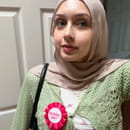
My first year at university was brutal. So brutal, I spent most of my time in my room, studying and overwhelmed, trying to juggle too many things at once. After a particularly jarring week, burnt out and wanting help, my classmate said to me, “You’re such a strong and independent person, I could never do what you do.” On the outside, I was the put-together version of me, openly joking about being tired, but on the inside, I was close to tears, my brain milling over a thousand things. It sounded like a compliment, but really all I heard was, “You’re on your own.”
Growing up, I was taught to be polite, quiet, and accommodating. Being called “strong” and “independent” felt like validation—the best compliments I could possibly receive. As a young Muslim woman, I always felt pressure to prove I’m not “oppressed” and that I’m not the epitome of a walking stereotype. Being strong and self-sufficient became a way to live, a part of my armour, what I would present every time I walked into a classroom, so no one could second-guess my place. Even now, I pride myself on doing it alone—managing school, work, family, expectations, faith, friendships—because it proves I’m capable. The glamorization of the “strong independent woman” on social media, like girlboss TikToks, made independence look aesthetic and aspirational. For a while, I wore “strong independent woman” like a badge of honour. But eventually, I realized that the badge came with a weight I never agreed to carry.
Even in weeks when I was stretched thin—shifts, assignments, family obligations, get-togethers—people responded with admiration rather than concern. In the weeks when I don’t even know how I managed it all, I got the same “You’re killing it” responses. And I know I am, and so many other women are too. But instead of this making me feel proud, I started to feel invisible; no one sees the cost. Real exhaustion becomes a Pinterest mood board: the iced coffees, the waking up at 6 a.m., the relentless work-study-gym routine. It showed only the aesthetic side of “grind culture.”
I internalized this for a long time: strong independent women don’t cry in public, don’t ask for extensions, and don’t show weakness. I have had multiple times where I clearly needed help, but I stopped myself from asking for it because I wanted to live up to that image. I thought, “Everyone else doesn’t complain, so why should I?” I couldn’t even lean on my loved ones because it felt like I had failed some unspoken test. Independence became less about choice and more about performance. It wasn’t that I didn’t need anyone; it was that I didn’t think I was allowed to show that I did. Being called strong started to feel less like encouragement and more like an excuse not to show up for me. Looking back now, it’s ironic because the moments I felt most like myself were the ones where I let people in.
I started to realize how these phrases are often used to gloss over real problems. Instead of addressing sexism at schools or in the workplace, people say, “You’ll rise above it, you’re strong.” Instead of acknowledging racism or Islamophobia, it’s “Don’t let them get to you.” Being tired, burnt out, or upset gets framed as a weakness rather than a typical response to unfair conditions. Being strong is great, but sometimes we don’t have to be. We’re allowed to cry, and we’re allowed to speak about it.
As students, we’re often told to be grateful for opportunities and to “push through” rather than to question why we’re being stretched so thin. As a Muslim woman, I get comments like “You’re so inspiring,” when really it just feels like I’m becoming this symbol of resilience I didn’t ask to be. We’re raised to believe this “feminist” message of “You can have it all,” when in reality we’re expected to do it all, but often with less support. Even feminist spaces sometimes celebrate women enduring more instead of demanding that we endure less. It always makes me think: how are we meant to do great things if we never truly receive a moment of rest? I don’t want empowerment that only works as long as I’m silently overachieving.
I don’t mean to swing to the opposite side of complete helplessness. I still value resilience and independence, and I believe we women should work hard because we’re capable. But I also value: asking for help without apologizing, letting yourself rest (even when your to-do list is unfinished), leaning on your loved ones, and saying no to things that drain you. Turning to faith, community, or family is not a sign of weakness but a fundamental part of being human. Instead of seeing the “strong independent woman” as someone who never breaks, never needs, and never falters, it’s time to see it as being honest about your limits, your softness, and the courage to be seen in your mess.
I’ve had to make changes in my own life to practice what I preach—slowly but surely. I will ask for help and extensions if I need them. I try to let my friends know if I’m emotionally tired and can’t be there. I let myself cry in front of people I trust. It’s important to move toward a version of strength that makes room for being human, not a role that requires me to be a superhero.
I was having a conversation with a friend during the fall semester of my second year at university. I was having a hard week and was expecting the same response I usually get in these conversations, but instead, she said, “Do you want help?” It opened up a door for me that I thought was closed a long time ago. I saw for the first time in a while that I didn’t have to be strong all the time. I didn’t have to act like I’m unbreakable; I only had to be honest. I’m okay with being called kind, complicated, and a work in progress. But don’t call me a strong independent woman if what you really mean is that I don’t deserve care. I don’t want to be admired from a distance for how much I can carry. I want to live close enough to other people that I won’t have to carry it alone.