



a recently unearthed tale
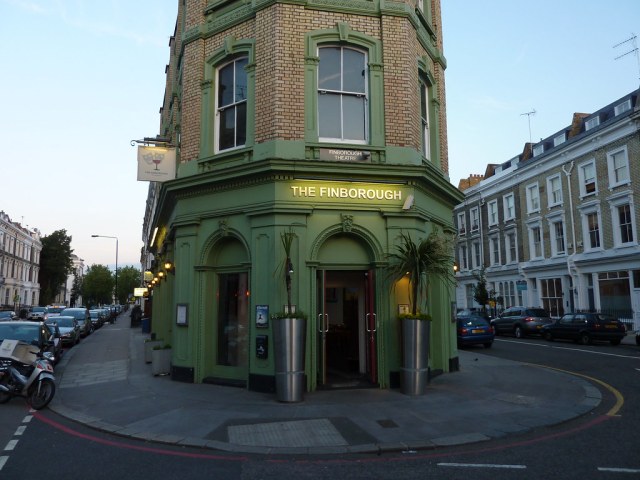
The Finborough Theatre is known for premiering gems among the theatrical world before they transfer to the West End and Off-Broadway, sometimes travelling globally. The currently sold-out show The Inseparables will surely be no exception. This book-to-stage adaptation is drawn from Simone de Beauvoir’s novel of the same title, written in 1954, although not released until 2020 when it was published posthumously. Adapted by Grace Joy Howarth and directed by Anastasia Bunce, the play follows Sylvie and Andrée, whose friendship is shaped by passion, intellectuality, and the rigid societal expectations that threaten to pull them apart. This play brings the joys and heartbreaks of female friendship vividly to life on stage.
the origin of the story
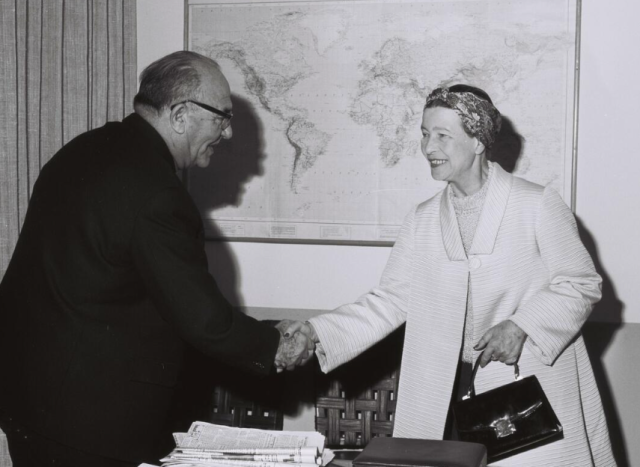
Photo of Simone de Beauvoir from Store Norske Leksikon
This intensely bittersweet story is a direct reflection of de Beauvoir’s own life. According to Penguin (2021), the company that published the novel, The Inseparables was actually de Beauvoir’s fourth attempt to capture her friendship with Elisabeth ‘Zaza’ Lacoin, someone Simone’s own daughter said, ‘completely enthralled her [Simone].’ The novel itself was dedicated to Lacoin, who passed away young and profoundly impacted Simone, saying, “I should dedicate this story to you, but I know that you no longer exist anywhere, and my writing to you like this is pure literary artifice.”
Critics pointed out that the book gave a rare look into Simone de Beauvoir’s emotional world, showing how important this friendship was to her life and future philosophical work. Readers found the story powerful and easy to connect with, making it feel both timeless and meaningful today.
An inside view of the production
I had the pleasure of interviewing director Anastasia Bunce to discuss how this play came to be and some of the messages the crew would like you to take away from your experience watching The Inseparables. The following is a transcription of the conversation:
Q: I wanted to start out with something fun and easy, if you had three words to sum up this entire play for the audience, what would you choose?
A: I’d say loving, multimedia, and heartfelt.
Q: Do you know what it was about this specific story that made you think that it was worth going from the page to the stage?
A: I actually picked up the book in 2020 when it first was published… I wasn’t looking to put it on as a play initially at all. I just was interested in Simone de Beauvoir and her writing… I was like okay it’s about female friendship, that’s kind of my cup of tea, read it and I just I was so moved by this story of these two young girls who then stay with each other throughout their young adult lives and how formative their friendship is and that’s the key part of the story and I thought that’s quite a rare thing to focus on, let alone in literature but in theatre and on stage as well. So when I read it I just thought it would be so beautiful on stage and I really wanted to capitalise on that theme and for women to come and see the play and see that that sort of friendship exists and to give that light on stage.
Q: Do you have any media that inspired how you adapted this to the stage?
A: Yeah, the main one was My Brilliant Friend [originally a novel by Elena Ferrante]. I had watched the TV series before rehearsals, before going into it, and I haven’t seen the play version, but I looked up reviews and different sort of photographs from it directed by Melly Still, and it was such a beautiful production…the thing I took away from it was that I wanted to do a very faithful adaptation of it on stage. Grace did a very faithful adaptation in her writing, and we wanted to keep that through how it was actually done visually on stage. I also love French new wave cinema, and I mentioned it being quite multimedia. There are some like cinematic moments to it where we have all characters on stage at the same time with overlapping dialogue, little moments… where they’re basically acting even though they don’t have dialogue on stage and we still have this continuous presence… using techniques that are quite cinematic to create this world so that it isn’t just the people who are speaking all the time on stage. So yeah, I’d say influence from French New Wave with that as well.
Q: You mentioned that you guys wanted to be very faithful to the book itself. If you could put a percentage on how much you changed or cut from the book, what would it be?
A: I’d say I’d say about 60% faithful, 40% adapting. [Discussing Grace Howarth] she did an amazing job with basically, it’s a four-hander [a play with only four speaking roles]. We’ve got Sylvie, her best friend Andrée, the love interest, Pascal, and the mother… [Grace] pulled the monologues and the narration and transformed them into dialogue. So there was a huge amount that she did change through doing that. But there are still quite a lot of lines that are faithful from the narration and from Sylvie’s monologues. There is a scene that Grace added, it wasn’t in the novel… and there’s some things she’s changed at the very end as well. But at the core of it she’s been very faithful, and there are lines that you can recognise if you know the novel that are in the play still.
Q: Did your team have any specific actors or local workers who you knew you wanted to work on it with or did it just naturally fall into place with time?
A: We didn’t have anyone specific in mind. We knew that we wanted to find French actors, so when we were looking for actors to invite to audition, I was looking at different French actors seeing who we could invite. We were really lucky that we did find two out of four of the cast are French. Alexandre, who plays Pascal, is French and Lara, who plays Andrée. It brought so much to the rehearsal process that they knew the culture that we were trying to represent and all the locations as well that were in the script… they’d grown up going to these locations and that brought so much to the rehearsal process. They were also able to help our British actors with pronunciation of names so that it felt really authentic. So that was a big thing that was quite important to me in the process. There’s a lot of movement in the show as well. Lara, she was a trained ballet dancer and brought so much to how effortless the movement is in it. So it wasn’t going in with a specific actor in mind, just the qualities that we wanted to find. And I have worked with a few actors before who I invited and Aisha, who plays Sylvia, I had worked with five years ago at the very first little scratch [in reference to a Scratch Night, where experimental works are presented to a live audience] that I directed and so we’ve come kind of full circle.
Q: You mentioned that you had some actors who knew the historical background of this, whereas some did not. Would you say that there’s any specific knowledge that the audience should go into this with?
A: I don’t think anyone needs to know anything historically going into it. I can tell sometimes audiences who might be fans of Simone de Beauvoir, or of French literature coming in… maybe they do get something out of it that audiences who don’t, do not get to the same level… but I would hope the aim is that anyone with any knowledge can come in and appreciate it for what it is. Though it is semi-autobiographical, if you know about Simone de Beauvoir’s life and philosophies, it’s great because you can kind of see where a lot of her feminist thought came out of and tie things back to her life and that’s satisfying. But if you don’t know that, then it’s just story and it’s not connected to her biography at all. And in its own right, you can still get a lot out of it.
Q: I wanted to focus on the themes of feminism for a moment and ask how you think this story’s content can be related to present day for a general audience?
A: Well, the story shows this woman, Andrée, and it shows her unravelment and how the society, the patriarchal Catholic society in which she was brought up, completely suffocated her. It was a really formative friendship for Simone de Beauvoir and a lot of her feminist thoughts and many scholars who write about Simone de Beauvoir have this lens on it where they do question how much was this friendship with Elisabeth Lacoin and seeing what happened to this woman, how much affected Simone de Beauvoir and how much that might have even seeped into her writings. Because we see this completely innocent woman, full of life, full of vigor, wanting to live her life, wanting to study at the Sorbonne. She was allowed, but then she was pulled out because she was upper middle class, and her family had different ideas for her. They thought she shouldn’t be a teacher on a clergyman’s wage, and that she was destined for greatness, and trying to marry her off to all these suitors, and we just witness her collapse amongst all of that. So how that’s relevant to today is I think… we know for a fact that women still don’t have freedom worldwide and a lot of women are still being pressured into marriage from an early age and not given rights into education and we forget that this is still an ongoing issue. So on that very literal level there is relation there. And also in the fact that we don’t see many female stories still being presented on stage. I mean, seeing something that capitalises on female friendship and not on the love interest and not on the man in the play is beautiful because it shows these two women who are there for each other and… how important female networks and connections are. So that’s something I would hope that people are able to take away from it and to try and capitalise on their female friendships and connections and supporting each other.
Q: Circling back to the actual production itself, could you picture in your mind a favourite moment that you’ve had during the creation of it all?
A: I’ll talk about the element of the music throughout the show. Andrée plays the violin and… we have these movement sequences when she plays the violin. It’s a non-naturalistic depiction but it captures her freedom and it captures that in these rare little moments when she’s actually left alone by her mother and not expected to be running around doing her social duties, how much she comes to life and we see her beauty and her freedom and her enjoyment when she has these moments of playing the violin. I really loved working on those moments throughout. We had an amazing movement director, Daniela Poch, who staged all of those sequences as well and that’s one of my favourite moments in the show.
Q: To touch on the opposite side, were there any challenges that really affected you whilst directing this production?
A: We didn’t have any major obstacles, but something that was challenging was the tech, because… we’re doing it on a fringe scale, and you have one day to tech the whole show. And I didn’t realise how tech heavy it was. It changes locations loads. We have a very simple and effective set so that was all fine but we have video with projection and a lot of sound and lighting cues so tech was really challenging to get that all in and to make it slick in one day. We had little moments where we’d have like a pink spotlight come in when Andrée is talking about a love that she had and little moments like that that really make the show, but we have something like 400 lighting and sound cues which is mental for a two-hour show but we got through it and we managed to get it all done in time!
Q: Were there any challenges that make working with a period piece different or harder than working with a more contemporary one?
A: Absolutely, there’s loads more research to be done to actually go to sources of 20s France and to learn about the politics and economy and just lifestyle and education because everything was completely different. It’s a hell of a lot of research to do to be able to make that authentic and believable because you don’t present that consciously in any shape or form in the play, but when you’re working in rehearsals you need to really seep into that world and marinate in it. So for me as a director it was a much longer period of research to do that but I really enjoyed that and on new plays you don’t have to do that because if it’s a contemporary play, and you’re in the contemporary world, you naturally understand how that world operates and functions. It’s also, from the point of view of production, costumes and set having to look authentic and detailed and that’s also harder to do. But we were lucky Grace actually made the costumes for the play and she did an amazing job with them and our set designer Hazel [Poole Zane] got some period pieces that hopefully made it look authentic.
Q: To finish off, what do you want people, especially young adults, to leave with after experiencing your adaptation of this story?
A: I want people to come out of it reflecting on what caused the collapse of this young woman, and to reflect on how, in my eyes, it was the harshness and the lack of empathy that destroyed her. It’s not a very tangible topic or feeling, but just to come out capitalising on if we were more empathetic with people, and if we prioritised people’s inner worlds and feelings and freedom and came to them with more sensitivity and support, that we could live in a much better world and support each other much more and that actually our words and actions to each other really matter because it can be the end of someone or it can be the beginning of their life. So yeah, very tender, delicate feelings, but to come out with that and to just also see how much Sylvie loved this woman, and Simone de Beauvoir wrote this to memorialise Elisabeth Lacoin so that people wouldn’t forget her.
Happy viewing!

The Inseparables speaks directly to the kind of questions many university students grapple with: figuring out who you are, what you believe, and how to stay true to that in a world that often wants to define you. Sylvie and Andrée’s story shows the intensity of friendships at that age, the kind that can feel like your whole world, while also exploring the pressure to meet expectations from family, school, or society. For students navigating identity, independence, and shifting relationships, this play will resonate on a deeply personal level. It’s a reminder that the touch of a true friendship lasts forever, especially for young women.