


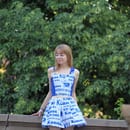
A few weeks ago, I had the opportunity to showcase my designs at KU Fashion Week (presented by FBO and Alpha Gang). It was my very first fashion show–I had never even attended a fashion show before, let alone designed for one. It took me several missing assignments and countless hours to complete, but somehow I pulled it off. Here’s how I made it happen:
My first task was conceptualizing my collection. When applications opened in December, I quickly realized how daunting the process was. I was asked for a brand name and committed to styling multiple models—far beyond my usual practice of designing pieces just for myself. I spent weeks debating themes, using my winter break to assess my inventory and figure out what was realistically achievable. I considered multiple themes, including KU, the forest, and Cars, I ultimately opted for a forest theme due to the materials I had on hand (and to avoid any trademark issues). With that decision made, I finally submitted my application in late January.

I brought a handful of materials back to school with me after winter break, but I hesitated to start until I was positive that I’d be designing. Weeks passed with no updates, and I assumed I hadn’t been accepted—especially when talk of model calls emerged without any word on designers. However, in late February, I finally received an email. Despite my doubts about pulling off a collection in such a short time, I attended the introductory meeting to learn more. Fortunately, instead of the initially stated 10 models, designers were expected to create 5-6 looks, which was much more manageable.
Once confirmed, it was time to get to work. I used elements from an older project—one I had paused because the individual pieces didn’t match cohesively. Rather than combining them into a single dress, I turned toward a full collection, which turned out to be a much better approach.
Of course, a fashion show requires models, and I had to meet mine. Since I hadn’t attended the casting call, I wasn’t sure what to expect. The process involved models grouping together and walking while designers were encouraged to approach them—a somewhat intimidating task for someone introverted and without a strong vision for model selection. Despite my hesitation, I did speak with several of them (if a bit awkwardly). Before making final decisions, however, I wanted to see their measurements.
Eventually, the designers received a spreadsheet with the models’ names, measurements, and contact information. While I factored in skill and suitability, I also prioritized models with measurements close to my own. Given my limited tailoring skills (and limited time), I knew minimizing alterations would save me valuable time.
Spring break was crucial to my progress. My mom brought me some materials from home, and I used the week to shop, experiment with designs, and refine my ideas. However, the process wasn’t easy—many of my concepts didn’t work as expected, and since most of my fabrics were thrifted, I couldn’t simply buy more when something didn’t go as planned (believe me, I tried). Adding to the stress, some designs couldn’t be started without knowing my models. It was easily the most stressful spring break I’ve ever had, but ultimately, I managed to develop some promising ideas.

Everything began falling into place at the first rehearsal. I brought a large selection of materials to narrow down my choices, relying on feedback from the models to determine what worked and what should be scrapped, leaving me with a much better concept of what to work on.
From that point on, it was all about execution. Since carrying entire dresses everywhere wasn’t an option, I took embroidery appliques with me to classes, working on them whenever I had the chance. Surprisingly, this didn’t distract me—it actually helped me focus better than my laptop, almost like a fidget toy. Unfortunately, however, it did interrupt my homework, and I’m still catching up on assignments.

Choosing the right music for my showcase was another challenge. I had a song in mind, but since it wasn’t available on traditional streaming platforms, I could only use it because neither my designs nor the tickets were being sold. While I was happy with my choice, I later realized the song was too short—an extended version would have worked better.

When fashion week finally arrived, I took the opportunity to show off designs I had made that wouldn’t be in the show. Most of my pieces were back home, but I had just enough on hand to display a few personalized looks. I saved the best for last, pairing my famous KU bodice with the KU cowgirl boots my mom had surprised me with that morning.
Overall, I don’t regret the experience—but I highly doubt I would do it again. While I might consider modeling in the future, designing was an overwhelming commitment, especially for someone doing it purely for fun with no related career goals or financial incentive. Without a working sewing machine, the process was even more difficult. The assignment time sacrificed (which I am still recovering from), not to mention the agonizing stress I went through trying to make my collection original, complete, and cohesive, took its toll. I usually prefer experimenting with individual designs rather than making cohesive collections, so for now, I think I’ll stick to creating pieces on my own terms.
Photos from the event can be found here.
For more information, check out my Instagram.