


Last week, I wrote a beginner’s guide to color analysis—including its history, what it is, and what it isn’t—and promised to write an article this week about how to find your color season. This is the hard part, but it doesn’t have to be as hard as it seems. Here’s how to find your color season from the comfort of your own home, without spending an exorbitant amount of money on a consultation with draping.
Here are some options, which you can do any combination of:
Analyze yourself.
If you’re choosing to analyze yourself, it’s best to have a fair amount of knowledge of color analysis. While I give you some background in last week’s article, since that was more of a survey, It may be helpful to learn by watching more videos or reading more articles, as well as looking at photos of people in a given color season.
Here’s how I recommend analyzing yourself this way. Do all of these steps in natural light.
- Find out if you’re warm or cool.
You have some options here. My personal favorite is to put gold jewelry on, then silver jewelry, and see which one makes you pop more and feel more harmonious. Which of the options feels like an extension of you? This Redditor gives a good example of how to do it. The gold in their photos is too rose gold. The only way this works is for you to use true silver-colored and true gold-colored jewelry—but the format is exactly right.
Another option is to do the vein test. This is looking at the veins on your wrist and determining how they appear—purple/blue, green, or a mix. If your veins appear more purple or blue, you are cool-toned. If they appear green, you are warm-toned. If they appear to be a mix, then you are likely more neutral-toned. I don’t like this method as much as the jewelry test as it can be more difficult to discern what qualifies as purple, blue, or green, and this also makes it more difficult for people with olive skin tones. However, here is an image of cool, neutral, and warm-toned individuals doing the vein test.
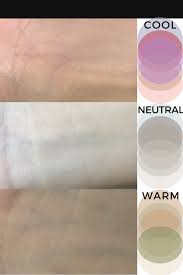
There’s also the white towel test, where you put your hair in a ponytail and wrap a white towel around your face. If you look more yellow, this indicates being warm-toned, while a bluer appearance is cool-toned. I don’t really like this one, personally. White draws attention away from so many people’s faces and nobody really wants to ask themself the question “Do I look yellow or blue?” Most people’s answer would, even subconsciously, be “I look more neutral.”
- Find out if you’re light or dark.
As I said last week, being a light or dark season is not the same as having light or dark skin, hair, and/or eyes. Things like this are often, but not always, an indicator, so it’s best not to rely on them. There are a few ways to find out if you’re light or dark.
The first thing I’d recommend is seeing if you can wear black. Put on black near your face and take a picture of yourself or look in the mirror. When you use a soft focus and look, does the black overwhelm you, or does it feel harmonious and complementary? Black overwhelms anyone who isn’t a Deep Autumn, any sort of Winter, or a Bright Spring, so if you’re not overwhelmed by black, you just ruled out a bunch of seasons. If you are, then you can rule out the seasons I just mentioned.
If you’ve figured out if you’re warm vs. cool-toned, here’s my favorite way of finding your lightness/darkness beyond what I just said. If you’re cool, look at yourself wearing black vs. dark grey. If black is better, you’re a deep season and definitely not a Summer. If dark grey is better, then you could potentially be a winter, but you’re probably a Summer. If you’re warm, try this with a deeper, warm orange vs. a lighter orange. If the deep orange is better, you’re probably an Autumn or perhaps a Bright Spring. If the lighter orange is better, you are probably a Spring or a Soft Autumn. There’s a little more crossover in the warm seasons.
- Find out if you’re soft or bright.
This can be a hard one, because almost everyone wants to be bright. This is fair. I, too, wanted to be bright. I love bright colors. My favorite way to test if you’re bright or soft is to think about it in terms of color theory. The hue is the base of the color (red, magenta, green, etc.). A tint of the color is if white is added (Light Springs, Summers). A shade is when grey is added (Soft Summer, Soft Autumn). A shadow means that black has been added (Deep Autumn, Winters). I recommend taking the color red and looking at things this way:
If you’re warm, look at these colors:

These are the same hue, but the one on the right is the pure hue, and the one on the right is softened significantly. Take a picture of your face in no makeup and natural light, cut out all dyed hair, and stick it on top of these two colors. Look at your face, not the color. Which makes it pop more? Does it fade into the background with one of the colors?
Likewise, if you’re cool, look at these colors:

Once again, same hue, different shades. The left is the pure hue, the right is that hue softened significantly. Use the same process as I mentioned for the warm colors.
It is important to note that not all palettes will have either of these colors. Particularly Light Springs and Light Summers will struggle with these colors. However, it’s about which works better rather than which works perfectly. You can even try taking those colors somewhere like Canva and messing around with the shade if you want to find something perfect for you.
- Figure out your dominant trait.
Sure, you’re cool, but can you pull off some warmer colors? Are you mostly defined by your softness? Or perhaps you’re bright, but your warmth is more important and bright, cool tones are too overwhelming. Everyone has one feature that is the most important. It’s most easily found by exploring other palettes and seeing what you can borrow from. If you feel confident that you’re a Summer, but some Soft Autumn colors suit you, then you’re probably a Soft Summer. If you’re a Spring, but you can pull off some Bright Winter colors, then you are probably a Bright Spring. If you’re a Winter who can pull off Cool Summer colors, you’re probably a Cool Winter. These are called your sister seasons.
Every season has its sister season, which is the season that starts with the same word as theirs and shares the same dominant trait:
- Cool Winter and Cool Summer: Cool
- Bright Winter and Bright Spring: Bright
- Warm Spring and Warm Autumn: Warm
- Light Spring and Light Summer: Light
- Soft Summer and Soft Autumn: Soft
- Deep Autumn and Deep Winter: Dark
With all of these steps, you hopefully have an idea of your season, or at least somewhere to start. This is similar to the process I ended up using—I realized that I was warm first, but actually discovered my softness before my darkness because I was relying too much on my light skin, slightly light hair, and slightly light eyes. I thought that I was a Light Spring because of the lightness I thought I had, comparing my coloring to Taylor Swift, who is a Light Spring. Light Springs aren’t very soft, but they are softer than the other Springs. I also really, really didn’t want to be an Autumn. I didn’t want to be fully soft. “Soft for a Spring” was all I could handle. I then got sad and resigned myself to Soft Autumn because I was sad about my softness (soft seasons are lovely, I just like living life pretending that I’m a Barbie). That’s why the next strategy was necessary for me, and I do recommend it to anyone planning on analyzing themself:
Try virtual draping.
I like the app Colorwise.me for this. Don’t pay for it, you don’t need premium. The free version lets you take a picture of your face and it automatically surrounds it with virtual drapes for all of the seasons. You scroll through them and then you can pick the one that makes your face pop more. That’s how I moved from Soft Autumn to Warm Autumn. Looking at the drapes, Soft Autumn softened me—it was almost as if there was a softening filter on the whole image despite there being none. When I looked at Warm Autumn, it felt as though the whole image—including my face—brightened, even though it was just the colors.
I think this experience is enhanced when you analyze yourself beforehand. I recommend going into something like Canva and pulling your face over colors in a given season more actively, but your instincts looking at the app will probably be accurate.
Look at celebrities and real-life examples of each color season.
This is especially helpful if you’re stuck between a few. Attached are pages with celebrities from each season. I personally disagree with some of these typings, but it should give you an idea.
- Deep Winters
- Cool Winters
- Bright Winters
- Bright Springs
- Warm Springs
- Light Springs
- Light Summers
- Cool Summers
- Soft Summers
- Soft Autumns
- Warm Autumns
- Deep Autumns
This website falls into the trap I want to caution people about—it types very, very few people of color as anything but Autumns, Winters, and Bright Springs (which is honestly better than some people, unfortunately). I’d like to add the following names to diversify some of the seasons that are focusing heavily on white people:
- Warm Springs
- Tracee Ellis Ross
- Jada Pinkett Smith
- Light Springs
- Sui He
- Jazz Sinclair
- Light Summers
- Nicki Minaj
- Cool Summers
- Denise Vasi
- Soft Summers
- Rihanna
- Zoe Saldaña
- Michelle Yeoh
- Leona Lewis
- Hannah John-Kamen
These are not the only examples of BIPOC people in these seasons by any means, but they are the celebrity examples I can immediately think of as Warm and Light Springs and all Summers. The list is not exhaustive by any means. As color analysis features are frequently reflected in a person’s hair and eyes, it is more common for BIPOC people to be Autumns, Winters, or Bright Springs, but, as is shown above, this is not always true.
In conclusion…
You don’t need to spend $100+ on an appointment to find your best colors. There are cheaper options that may be more difficult, but you don’t have to spend money. Nobody wants to spend more money than they need to. What matters the most is that you feel good in the clothes you wear. In my experience, color analysis is a tool for just that. Realizing that I could analyze myself for free made shopping and dressing more fun. I still wear non-Warm Autumn clothing, but now, whenever I go shopping, I get so excited when I find something that is both cute and in my palette. Color analysis turns shopping into a scavenger hunt for me, and I love looking in the mirror and seeing myself in colors that harmonize with me and make me shine. If that’s what you want, I highly recommend investing your time, rather than your money, into finding your best colors, too.